The short answer
- Don't switch to raw expecting proven health benefits; beyond firmer stools and changes in gut bacteria, the evidence is thin.
- Feed raw only from a complete and balanced commercial product, or a recipe written by a qualified vet nutritionist, never a home mix.
- Don't feed raw if anyone at home is under five, pregnant, elderly, having chemotherapy or otherwise immunocompromised.
- Handle raw dog food like raw chicken: defrost it in the fridge, keep it away from human food and wash hands and bowls every time.
- Tell your vet your dog eats raw, because it changes what they look for when your dog is ill.
Raw feeding has not been shown to make dogs healthier than a complete, balanced cooked diet, and it carries real, measured risks: raw pet foods regularly test positive for Salmonella, Listeria and antibiotic-resistant E. coli, and home-made raw diets are often short of key minerals. That’s the position of the World Small Animal Veterinary Association (WSAVA), and it’s broadly shared by veterinary bodies in the UK and US.
None of this means a raw-fed dog is doomed, or that owners who choose it are careless. It means the benefits are mostly unproven while the risks are documented, so if you do feed raw, you need to do it carefully.
What counts as raw feeding
Raw meat-based diets, sometimes called BARF (“biologically appropriate raw food” or “bones and raw food”), are built on uncooked muscle meat, offal and bone, sometimes with vegetables, fruit and supplements.
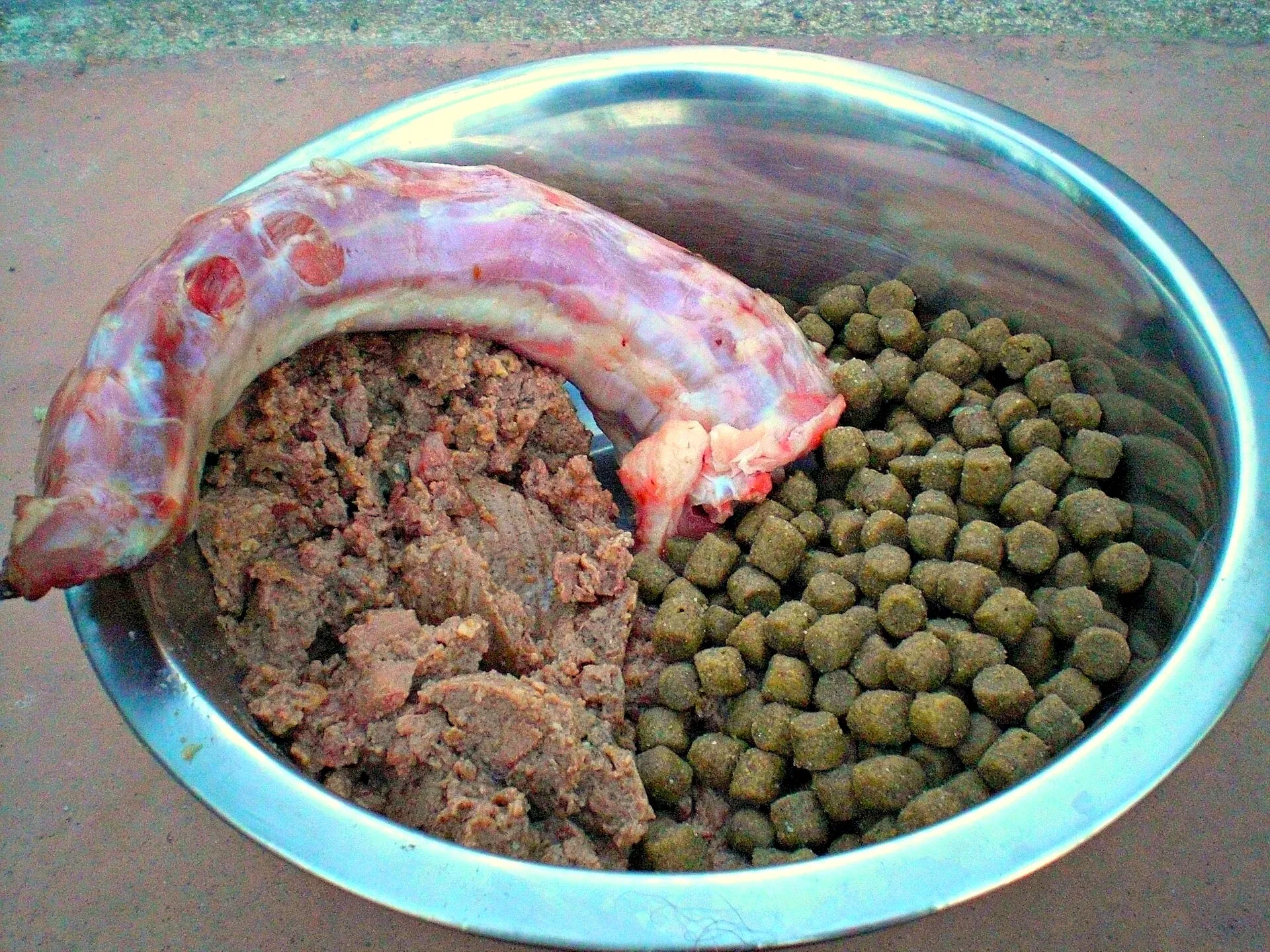
They come in a few forms:
- Commercial frozen raw, sold as complete meals or as minces you add to
- Freeze-dried or air-dried raw, which is shelf-stable but still uncooked
- Home-made raw, mixed from butcher or supermarket ingredients
- Raw meaty bones and chews, fed alongside other food
WSAVA notes these diets tend to be higher in fat and lower in carbohydrate than most kibble, and can be very digestible. But they vary widely in ingredients, energy content and nutritional profile, exactly as cooked foods do.
The claimed benefits, and what the evidence shows
Raw-feeding advocates claim a long list of benefits, from shinier coats and firmer stools to cleaner teeth, better energy and fewer allergies. A 2019 review in the Journal of Small Animal Practice looked at the evidence behind these claims. It found formal evidence for an altered gut microbiome and, subjectively, better stool quality. For most of the wider list of benefits, it found no solid evidence and no plausible mechanism to explain them.
WSAVA’s guidance is blunter: “There is no evidence that raw meat-based diets provide health benefits over commercial or balanced homemade cooked diets.” It adds that high-fat, low-fibre diets, raw or cooked, suit many dogs but can cause diarrhoea or even pancreatitis in others.
The most interesting evidence on the other side comes from Finland’s DogRisk project. A 2021 study of 4,022 dogs found that puppies who ate raw tripe or raw organ meats were less likely to have owner-reported allergy and itchy-skin signs after their first year, while puppies fed more heat-processed foods were somewhat more likely to. The authors are careful to say it suggests a link but does not prove cause: it relied on owners’ recall and reports, and families who feed raw may differ in other ways too. It’s a reason for more research, not a settled answer.
The pathogen data
Contamination of raw pet food isn’t a theoretical worry. It turns up in study after study, in several countries.
| Study | Country and years | What they tested | What they found |
|---|---|---|---|
| US FDA Center for Veterinary Medicine | US, 2010–2012 | 196 raw dog and cat food samples | 15 positive for Salmonella and 32 for Listeria monocytogenes; other pet food types had few or none |
| van Bree et al., Veterinary Record | Netherlands, published 2018 | 35 frozen raw products from 8 brands | E. coli O157:H7 in 23%, drug-resistant (ESBL) E. coli in 80%, Listeria monocytogenes in 54%, Salmonella in 20%, Toxoplasma in 6% |
| Groat et al., J Small Anim Pract | UK, samples 2015, published 2022 | Faeces from 114 raw-fed and 76 non-raw-fed dogs | Antibiotic-resistant E. coli in 54% of raw-fed dogs vs 17%; resistance to third-generation cephalosporins in 31% vs 4%; Salmonella in 8 raw-fed dogs and none of the others |
The antibiotic resistance finding matters beyond your own dog. Cephalosporins of this kind are classed as critically important antibiotics in human medicine, and the 2019 review describes raw-fed pets as creating “an elevated risk of shedding such resistant bacteria”. The same review notes Brucella suis, a livestock disease that can infect people, was identified in raw pet meat imported into the EU and UK from Argentina.
Freezing doesn’t solve the problem. WSAVA says freezing, dehydration and freeze-drying “do not kill all bacteria in food”.
Who is at risk at home
The dog is often fine. Many raw-fed dogs carry Salmonella or resistant bacteria without ever looking ill, but they still shed them in saliva and faeces. WSAVA warns that people in the household can be infected by handling the food or the dog’s stools, even if they’re not the one doing the feeding.
The people most at risk are:
- Children under five. UK health agencies (UKHSA and APHA) say young children should not touch or eat raw pet food or treats.
- Pregnant people, who are also at risk from Toxoplasma.
- Older adults.
- Anyone immunocompromised, including people on chemotherapy, steroids or other immune-suppressing drugs.
The British Small Animal Veterinary Association (BSAVA) advises that where there are children or immunocompromised adults in the household, medical advice should be sought before preparing, handling or storing raw pet food. WSAVA also notes that raw-fed pets can be a risk to other patients at the vet clinic, so tell your vet what your dog eats.
Nutritional balance: where home-made raw often falls short
Getting raw meat, offal and bone into the right proportions is harder than it looks.
A study of 95 raw rations fed to adult dogs in Germany, published in the British Journal of Nutrition in 2011, calculated what each one actually supplied:
- 60% had at least one significant imbalance.
- 10% supplied less than a quarter of the recommended calcium.
- About half supplied less iodine than the minimum requirement.
- A quarter supplied 70% or less of the recommended vitamin A.
- Many were low in zinc and copper.
The remaining 40% were either balanced or had only minor problems, such as too much calcium from bones. WSAVA warns that unbalanced diets are especially harmful for puppies, which can develop painful skeletal disorders and fractures.
The BSAVA strongly recommends that all pets eat a complete and balanced diet, and that anyone feeding a home-prepared diet gets veterinary advice to confirm it’s complete. In practice, that means a recipe from a board-certified veterinary nutritionist, or a commercial product labelled “complete” for your dog’s life stage. Our guide on how to choose a dog food explains what to look for on the label, and the dog food calculator helps with portion sizes.
Bones: the part with the most obvious risk
Raw meaty bones are often fed for enjoyment and to clean teeth. WSAVA says they can cause broken teeth, blockages in the gut or oesophagus, and constipation, and that feeding bones does not reduce plaque or tooth loss from gum disease. Cooked bones are worse, because they splinter.
If you do give bones, supervise, choose a size your dog can’t swallow whole, and take it away once it’s small enough to fit in the mouth. Watch for the warning signs in the box below.
See a vet now if:
- Your dog is retching, gagging, drooling heavily or pawing at its mouth after eating a bone
- Your dog is straining to pass faeces, or passing small, hard, chalky stools with blood
- Your dog has repeated vomiting, a swollen or painful belly, or won’t eat
- Your dog has bloody diarrhoea, a fever or is unusually lethargic after a diet change
- A puppy on a home-made diet is limping, reluctant to move or seems sore when touched
- Anyone in your household becomes ill with diarrhoea or fever, and see a doctor for them too
What vet and health bodies around the world say
- WSAVA (global): no evidence of health benefits over complete cooked diets, a high risk of bacterial contamination, and a risk of nutritional deficiencies in home-prepared diets.
- US FDA: its testing “identified a potential health risk for the pets eating the raw food, and for the owners handling the product”.
- UK (UKHSA and APHA): official handling advice, including keeping raw pet food away from children under five.
- BSAVA (UK): strict hygiene for raw-fed pets and vet advice for home-made diets.
No major veterinary body we found recommends raw feeding as healthier, though several accept that owners may choose it and focus on making it safer.
If you choose to feed raw: how to do it more safely
Drawing on the FDA and UKHSA advice:
- Buy complete, not just meat. Choose a commercial raw food labelled complete for your dog’s life stage, from a maker that tests its products.
- Keep it frozen until needed and defrost in the fridge, not on the counter.
- Store it separately, in a dedicated, sealed container, away from human food and food-preparation areas.
- Wash your hands with soap and hot water for at least 20 seconds after handling it.
- Clean, then disinfect bowls, utensils and surfaces the food has touched.
- Throw away leftovers promptly.
- Skip the face licks. The FDA advises against letting raw-fed pets lick your face.
- Pick up poo straight away and wash your hands after.
- Tell your vet your dog is raw-fed, because WSAVA says it can change what they look for when your dog is ill.
If your dog’s stools change for more than a day or two after a switch, our guide to dog diarrhoea covers what’s normal and what isn’t.
The bottom line
Raw feeding is a choice, not a health upgrade. The benefits claimed for it are mostly unproven, beyond firmer stools and changes in gut bacteria, and the risks of contamination, drug-resistant bacteria and unbalanced home recipes are documented in several countries. If anyone in your home is very young, pregnant, older or immunocompromised, a cooked complete diet is the safer call. If you do feed raw, buy a complete commercial product, handle it like raw chicken, and keep your vet in the loop.
Questions owners ask
Does freezing raw dog food kill bacteria?
No. WSAVA says freezing, dehydration and freeze-drying do not kill all bacteria. Freezing can kill some parasites, but Salmonella, Listeria and E. coli can survive.
Is raw feeding better for a dog's teeth?
There's no good evidence that it is. WSAVA says feeding bones does not reduce plaque or tooth loss from periodontitis, and bones can break teeth or block the gut. Brushing is the method with the best evidence.
Can a raw-fed dog make my family sick if it seems healthy?
Yes. Dogs fed raw diets can carry and shed bacteria such as Salmonella in their saliva and faeces without showing any signs. That's why vets advise extra care in homes with young children or people with weakened immune systems.
Is lightly cooked or 'gently steamed' dog food safer?
Possibly a little, but UK health agencies warn that lightly steamed or lightly cooked pet foods may not be fully pasteurised and can still contain harmful bacteria. Treat them with the same care as raw.
Can puppies be fed raw?
It's riskier. Puppies are more vulnerable to infections and to mineral imbalances. WSAVA warns that unbalanced diets can cause painful skeletal disorders and fractures in growing dogs, so if you're considering raw for a puppy, talk to your vet first.
Sources
- WSAVA Global Nutrition Committee: Raw meat based diets for pets (2021)
- US FDA: Get the facts! Raw pet food diets can be dangerous to you and your pet
- UKHSA and APHA: Raw pet foods: handling and preventing infection
- BSAVA: Position statement on companion animal nutrition
- Davies, Lawes and Wales (2019): Raw diets for dogs and cats: a review, Journal of Small Animal Practice
- van Bree et al. (2018): Zoonotic bacteria and parasites found in raw meat-based diets for cats and dogs, Veterinary Record
- Groat et al. (2022): UK dogs eating raw meat diets have higher risk of Salmonella and antimicrobial-resistant E. coli faecal carriage, Journal of Small Animal Practice
- Dillitzer, Becker and Kienzle (2011): Intake of minerals, trace elements and vitamins in bone and raw food rations in adult dogs, British Journal of Nutrition
- Hemida et al. (2021): Puppyhood diet as a factor in the development of owner-reported allergy/atopy skin signs in adult dogs in Finland, Journal of Veterinary Internal Medicine
This guide is general information, not a substitute for advice from a vet who has examined your dog. Every claim is checked against the sources above. How we research and fact-check. Spotted an error? Tell us.