The short answer
- Watch for changes in normal habits, like slower walks, trouble getting up or licking one spot, rather than waiting for crying.
- Don't assume a wagging tail or a friendly greeting means your dog isn't in pain.
- Never give your dog human painkillers such as ibuprofen, naproxen or paracetamol, and call a vet or poison line if they swallow one.
- Film short videos of your dog getting up, walking or using stairs, because a vet may not see the problem in the clinic.
- Keep a short weekly note on how your dog rises, handles stairs and enjoys walks to give your vet clearer information.
Dogs in pain rarely cry out. The most common signs are changes in normal behaviour: moving less, struggling to get up, reluctance to jump or use stairs, licking one spot, eating less, sleeping restlessly, becoming withdrawn or snapping when touched. Sudden pain is easier to spot (limping, yelping, a hunched back). Chronic pain from arthritis, dental disease or other long-term problems creeps in slowly and often gets dismissed as “just getting old.” If you notice a change that lasts more than a day or two, book a vet check.
Why dogs hide pain so well
Dogs are good at carrying on. Many will still greet you at the door, wag their tail and fetch a ball while sore. The Merck Veterinary Manual points out that tail wagging and friendly greetings don’t rule out pain, which catches a lot of owners out.
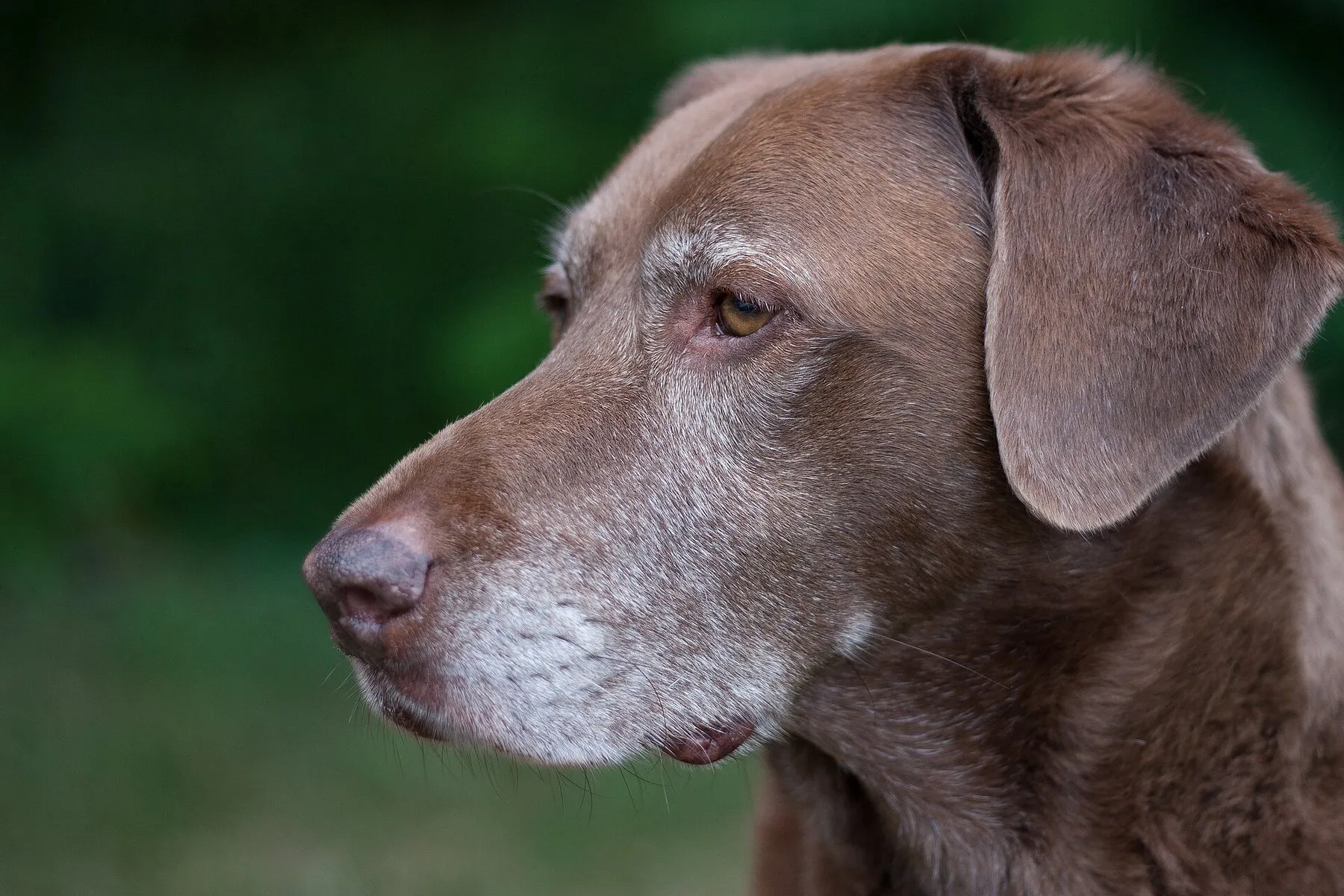
Vets also face a problem: the dog in the consulting room is excited, nervous and full of adrenaline, and may hide a limp it shows every morning at home. That’s why vets lean heavily on what owners notice. You see your dog every day, so you’re the one most likely to spot that something has shifted.
According to a review in Today’s Veterinary Practice, the change owners most often notice is a dog no longer doing things it used to do. New, obviously abnormal behaviours like crying or limping are noticed less often.
Behavioural signs of pain in dogs
These are the changes to watch for. One on its own may mean nothing. Several together, or one that persists, is worth a vet visit.
Activity and movement
- Slower on walks, lagging behind or wanting to turn home early
- Reluctant to jump into the car or onto the sofa
- Hesitating at stairs, or taking them one at a time
- Stiff when getting up, especially after rest, then “warming up”
- Less interest in play, or stopping a game sooner than usual
Rest and sleep
- Restless at night, getting up and lying down repeatedly
- Struggling to settle, circling for a long time
- Sleeping in new places (cold floors, away from the family)
- Lying in unusual positions, or sitting rather than lying
Mood and interaction
- Withdrawn, hiding or seeking less contact
- Unusually clingy
- Grumbling, growling or snapping when touched or lifted
- Less tolerant of other pets or children
- Startling or reacting more to noises
Self-care and daily habits
- Licking, chewing or staring at one area (a paw, a joint, a flank)
- Less grooming in dogs that normally keep themselves clean
- Eating less, dropping food, or chewing on one side
- Toilet accidents, or difficulty squatting or lifting a leg
- Not wanting to be brushed in a particular area
Physical signs to look for
- Limping or uneven weight-bearing, including standing with one leg slightly lifted
- Posture changes: a hunched back, head held low, tucked tail, or a “prayer position” (front end down, rear end up), which can indicate belly pain
- Panting at rest when the dog isn’t hot or excited
- Trembling or shaking
- Facial tension: squinting, ears flattened or pulled back, a tight mouth
- Swelling, heat or sensitivity over a joint or body part
- Muscle loss in one leg compared to the other, which can be a sign a dog has been offloading that leg for weeks
- Weight loss and reduced appetite, which Merck lists as possible signs of chronic pain alongside reduced activity and grooming
Merck also notes that heart rate, breathing rate and pupil size can rise with acute pain, but these changes aren’t specific enough to tell pain apart from stress or excitement.
Some signs are not specific to pain. A dog moving less might have heart, hormonal or neurological disease instead. That’s another reason a vet exam matters more than guessing.
How vets measure pain: validated pain scales explained
Pain is subjective, so researchers have built questionnaires that turn observations into scores. A “validated” scale has been tested to check that it measures what it claims to, gives similar results when different people use it, and changes when pain changes. These are the three you’re most likely to hear about.
Glasgow Composite Measure Pain Scale (short form)
Developed at the University of Glasgow, the CMPS-SF is used by vets and vet nurses to score acute pain, typically after surgery or injury, in hospital. A trained assessor watches the dog, approaches it and gently presses near the wound, then scores six categories:
- Vocalisation
- Attention to the wound
- Mobility
- Response to touch
- Demeanour
- Posture and activity
The maximum score is 24. A score of 6 or more out of 24 (or 5 out of 20 if the dog can’t be walked) is the usual threshold for giving more pain relief, according to a 2021 scoping review in Frontiers in Veterinary Science. The scale is meant to support clinical judgement, not replace it, so a dog scoring under the threshold can still get pain relief if the vet thinks it needs it.
This isn’t a scale owners usually fill in, but it’s useful to know that your dog’s post-operative care may be guided by it.
Helsinki Chronic Pain Index (HCPI)
The HCPI was developed at the University of Helsinki for chronic pain from osteoarthritis, and it’s filled in by owners. It has 11 questions, each scored 0 to 4, covering:
- Mood and liveliness
- Vocalisation
- Willingness to walk, trot and gallop
- Willingness to jump and play
- Ease of lying down and getting up
- How the dog moves after rest and after heavy exercise
Higher scores mean more pain. The form is free, and vets often ask owners to complete it before and after starting treatment to see if it’s working. One quirk is that owner scores sometimes improve even on a placebo, because owners hope to see improvement. Today’s Veterinary Practice describes a study where HCPI scores improved in both treated and placebo groups while objective gait measurements got worse in the placebo dogs. Honest scoring helps your vet.
Canine Brief Pain Inventory (CBPI)
The CBPI was developed at the University of Pennsylvania and adapted from a questionnaire used in human medicine. Owners rate their dog on a 0–10 scale in two groups:
- Pain severity: pain at its worst, least and average over the past week, and right now
- Pain interference: how much pain affects general activity, enjoyment of life, rising from lying down, walking, running and climbing stairs
There’s also an overall quality-of-life rating. Merck notes it has been validated for osteoarthritis and bone cancer in dogs.
Other tools you might come across
The Liverpool Osteoarthritis in Dogs (LOAD) questionnaire and the Cincinnati Orthopedic Disability Index (CODI) are other owner-completed arthritis tools. Quality-of-life scales are also used for dogs with cancer or in old age. Facial “grimace scales” exist for cats, horses, rabbits and several other species, but Merck notes that dogs aren’t yet on that list.
You don’t need to score your dog formally. But keeping a short weekly note of how your dog gets up, handles stairs and enjoys walks gives your vet far better information than “I think he’s a bit stiff.”
Never give your dog human painkillers
This is the single most important point in this guide. Common human painkillers can seriously harm dogs, even at doses that seem small.
- Ibuprofen (Advil, Nurofen and others): Merck describes a narrow margin of safety in dogs. It can cause sudden vomiting, diarrhoea and belly pain, stomach ulcers that can perforate, and kidney damage. Severe cases involve seizures, coma and death.
- Naproxen (Aleve, Naprosyn and others): has caused bleeding into the gut, perforating ulcers and anaemia in dogs. Black, tarry stools are a warning sign.
- Aspirin: dogs tolerate it better than cats, but prolonged use can still cause stomach ulcers, and poisoning can affect the liver and blood clotting.
- Paracetamol / acetaminophen (Tylenol, Panadol and others): dogs are less sensitive than cats, but high or repeated doses can damage the liver and kidneys.
Why are these drugs riskier in dogs? Dogs handle many drugs differently from people, and for some, such as ibuprofen, the gap between a dose that helps and one that harms is small. Tablet strengths are also made for adult humans, so even a “small” tablet can be a big dose for a 7 kg (15 lb) terrier.
Combining drugs is another danger. If your dog is already on a prescribed anti-inflammatory or a steroid and you add a human pill, the risk of ulcers and kidney injury rises. Tell your vet about anything you’ve already given.
Vets do have safe, effective options: dog-licensed anti-inflammatories, other painkillers, joint supplements, weight management, physiotherapy and more. Some human drugs are occasionally prescribed for dogs, but only at doses your vet calculates. Any medicine should be given only under your vet’s direction.
If your dog has swallowed a human painkiller, call your vet or a pet poison helpline (such as the ASPCA Animal Poison Control Center in the US, on (888) 426-4435) straight away, with the drug name, strength and number of tablets.
See a vet now if:
- Your dog cries out, yelps when touched or can’t settle at all
- Your dog can’t stand, won’t put any weight on a leg, or is dragging its back legs
- The belly is swollen or hard, or your dog is retching without vomiting
- Your dog is in a “prayer position”, hunched, or panting heavily at rest
- You see pale gums, collapse, or fast, laboured breathing
- Your dog has eaten any human painkiller
- Pain follows a fall, road accident or fight, even if your dog seems fine
Common causes of hidden pain
- Osteoarthritis in older dogs and in large breeds, or dogs with hip or elbow dysplasia
- Dental disease, including fractured teeth and tooth root abscesses, which rarely stop dogs eating completely
- Back and neck problems, particularly in Dachshunds, French Bulldogs and other breeds prone to disc disease
- Ear infections, which can make dogs head-shy
- Cruciate ligament injuries in the knee
- Belly pain from pancreatitis, gut problems or bladder stones
- Cancer, including bone cancer in large and giant breeds
What to do if you think your dog is hurting
- Write down what you’ve seen and when it started. Short phone videos of your dog getting up, walking or climbing stairs are very helpful, because the vet may not see it in the clinic.
- Don’t give any medicine unless your vet has told you to.
- Rest your dog in the meantime: lead walks only, no jumping or rough play.
- Book an appointment. Mention every change, including the small ones.
- Follow up. For chronic pain, ask your vet whether a questionnaire like the HCPI or CBPI would help track progress.
Pain treatment for long-term conditions such as arthritis can involve years of medication and regular check-ups, and costs vary a lot by country and clinic. Owners who insure early, before a condition shows up, are generally better placed, because most policies exclude pre-existing conditions.
The bottom line
Dogs show pain mostly through changes in what they normally do: slower walks, trouble rising, restless nights, licking one spot, grumpiness when touched. Trust those small shifts, film them and take them to your vet, who can use validated tools like the Glasgow scale, HCPI or CBPI to judge severity and track treatment. Never reach for your own painkillers. Ibuprofen, naproxen, aspirin and paracetamol can cause ulcers, kidney damage or liver damage in dogs, and the right treatment comes from your vet.
Questions owners ask
Do dogs cry when they are in pain?
Some do, especially with sudden injuries, but many dogs in ongoing pain stay quiet. Changes in how they move, rest, eat and interact are far more common signs than whining.
Can a dog wag its tail and still be in pain?
Yes. The Merck Veterinary Manual notes that dogs may wag and greet people normally while in pain, so a happy greeting doesn't rule it out.
What can I give my dog for pain at home?
Nothing from your own medicine cabinet unless your vet tells you to. Dogs need vet-prescribed pain relief at a dose worked out for their weight and health, and human drugs such as ibuprofen and naproxen can cause stomach ulcers and kidney damage.
Is my older dog slowing down because of age or pain?
Often it's pain, most commonly from arthritis. If a dog becomes more active after a vet starts pain relief, that's a strong hint that pain was behind the change.
What is the Helsinki Chronic Pain Index?
It's a free 11-question form, developed at the University of Helsinki, that owners fill in to track chronic pain from osteoarthritis. Vets use the scores to see whether treatment is working.
Sources
- Merck Veterinary Manual: Recognition and Assessment of Pain in Animals
- Today's Veterinary Practice: Assessing Chronic Pain in Dogs
- Frontiers in Veterinary Science: The Short Form of the Glasgow Composite Measure Pain Scale in Post-operative Analgesia Studies in Dogs, a Scoping Review
- Merck Veterinary Manual (Pet Owner Version): Poisoning from Human Over-the-Counter Drugs
- ASPCA Animal Poison Control Center
This guide is general information, not a substitute for advice from a vet who has examined your dog. Every claim is checked against the sources above. How we research and fact-check. Spotted an error? Tell us.