The short answer
- Film the first 30 to 60 minutes after you leave, because boredom and distress can look alike from the damage.
- Get a vet check first, since pain, urinary problems and cognitive decline can look like separation problems.
- Train absences in steps small enough that your dog never panics, going back to a shorter time if you see whining or pacing.
- Arrange a sitter, friend or day care while you train, so your dog isn't left longer than they can cope.
- Don't punish, let them cry it out or rely on a crate, because each of these can make a worried dog worse.
Separation anxiety is real distress when a dog is left alone, and it shows up as howling, destruction near doors, toileting indoors, drooling or pacing that starts soon after you leave. Not every dog who chews the sofa while you’re out is anxious; some are bored or under-exercised. The way to tell is to film your dog, rule out medical causes with your vet, then train gradual absences at a pace your dog can handle, with professional help and sometimes medication for moderate to severe cases.
Separation anxiety, separation-related problems and boredom
Vets and behaviourists increasingly use the broader term separation-related problems (SRPs), because not every dog who struggles when alone is anxious. A 2020 study by de Assis and colleagues analysed owner reports on 762 dogs and found four broad patterns:
- Exit frustration: the dog focuses on getting out or getting to you, scratching at doors and exits.
- Redirected reactivity: the dog reacts to noises and people outside and takes the frustration out on objects.
- Reactive inhibited: the largest group, with barking at outside triggers and moderate signs of panic around departures, but little door-focused destruction.
- Boredom: a mixed group with milder, less consistent signs, including some fairly relaxed dogs with only occasional unwanted behaviour.
The authors stress that these are hypotheses, not settled diagnoses. The practical point holds, though: a bored adolescent Labrador and a panicking rescue Greyhound can both wreck a room, and they need different help.
Clues that point to boredom: destruction is spread around rather than focused on exits, the dog looks relaxed on camera, it happens after long absences rather than within minutes, and the dog is young, under-exercised or under-stimulated.
Clues that point to distress: the RSPCA notes that problems usually start within a few minutes and up to 30 minutes of you leaving, or even as you get ready to go. Damage clusters around doors and windows. You may see trembling, panting, drooling, pacing or a dog who won’t touch a food toy until you come home.
Signs to look for
The RSPCA lists these signs of separation-related behaviour:
Common:
- Barking, howling or whining
- Destructive chewing or scratching, especially at doors, exits or windows
- Toileting indoors in a house-trained dog
- Anxiety as you prepare to leave
- Over-the-top excitement when you return
Less obvious:
- Panting, trembling or excessive drooling
- Pacing, circling or other repetitive movement
- Over-licking paws or other self-injury
- Vomiting
- Refusing food or chews while alone
According to the RSPCA, around half of affected dogs show no obvious signs at all while you’re home. That’s why filming matters.
See a vet now if: your dog has injured themselves trying to escape (broken teeth or claws, cut gums or paws), is vomiting or not eating, has started toileting indoors suddenly, or the behaviour began suddenly in an older dog. Pain, urinary problems, gut problems and cognitive decline can all look like separation problems, and some need treatment urgently.
Step one: film your dog
Set up a phone, laptop or pet camera before your next absence and record at least the first 30 to 60 minutes. Watch for:
- When the behaviour starts, in minutes after you leave
- Where it happens, at the exit or spread around
- Body language: relaxed and busy, or panting, pacing and whining
- Whether your dog eats the chew or food toy you left
Bring the footage to your vet appointment. It’s the single most useful thing a vet or behaviourist can see, and it saves guesswork.
How common is it?
Very. Studies cited by de Assis and colleagues estimate that somewhere between about 22% and 55% of dogs show some separation-related signs, and these problems make up 14–40% of referral cases seen by behaviour specialists. A 2024 UK study by the Royal Veterinary College and Dogs Trust found that nearly half of six-month-old puppies in its sample (46.9%) showed at least one separation-related behaviour, most often pacing.
That same study found puppies were at higher risk when owners punished or ignored unwanted behaviour, or made a big fuss on returning after the puppy had misbehaved. Puppies confined to a crate or room overnight before 16 weeks, and those sleeping nine or more hours a night, were at lower risk. The researchers say they can’t yet tell whether these factors cause the problems, but calm departures and calm returns cost nothing.
A gradual-absence training plan
The core treatment is desensitisation: teaching your dog, in tiny steps, that being alone is safe. It works only if your dog stays below the point of panic. Every time they’re left long enough to panic, you lose ground.
Before you start: stop the panic episodes
This is the hard part. While you train, try not to leave your dog for longer than they can cope with. Options include a dog sitter, a friend or neighbour, day care if your dog enjoys it, taking them to work, or a dog walker for shorter gaps. The RSPCA advises that adult dogs generally shouldn’t be left for more than four hours anyway, and puppies much less.
Stage 1: Calm at home, with you there
- Teach your dog to settle on a bed or mat while you’re in the room. Reward calm behaviour with a treat, a quiet word or a chew.
- Practise you moving around the room, then out of sight for a second, and back.
- Keep your comings and goings dull.
Stage 2: Defuse departure cues
Many dogs start to worry when they see you pick up keys, put on shoes or reach for a coat. Do these things at random times without leaving, so they stop predicting your absence.
Stage 3: Short absences, slowly lengthened
- Step outside the door and come straight back before your dog reacts. Seconds count at first.
- Build up the time slowly. The RSPCA’s own sequence goes from stepping out of the room, to out the front door, to longer absences, with the speed set by your dog’s reactions.
- Watch your camera. If you see whining, pacing or a frozen, watchful dog, the step was too big. Next session, go back to a shorter absence your dog managed calmly.
- Several short sessions a day beat one long one.
- Once your dog copes calmly with about an hour, the RSPCA suggests you can start varying absence lengths more.
Stage 4: Make alone time predictable and comfortable
- Exercise and feed your dog before you go, and give them a chance to toilet.
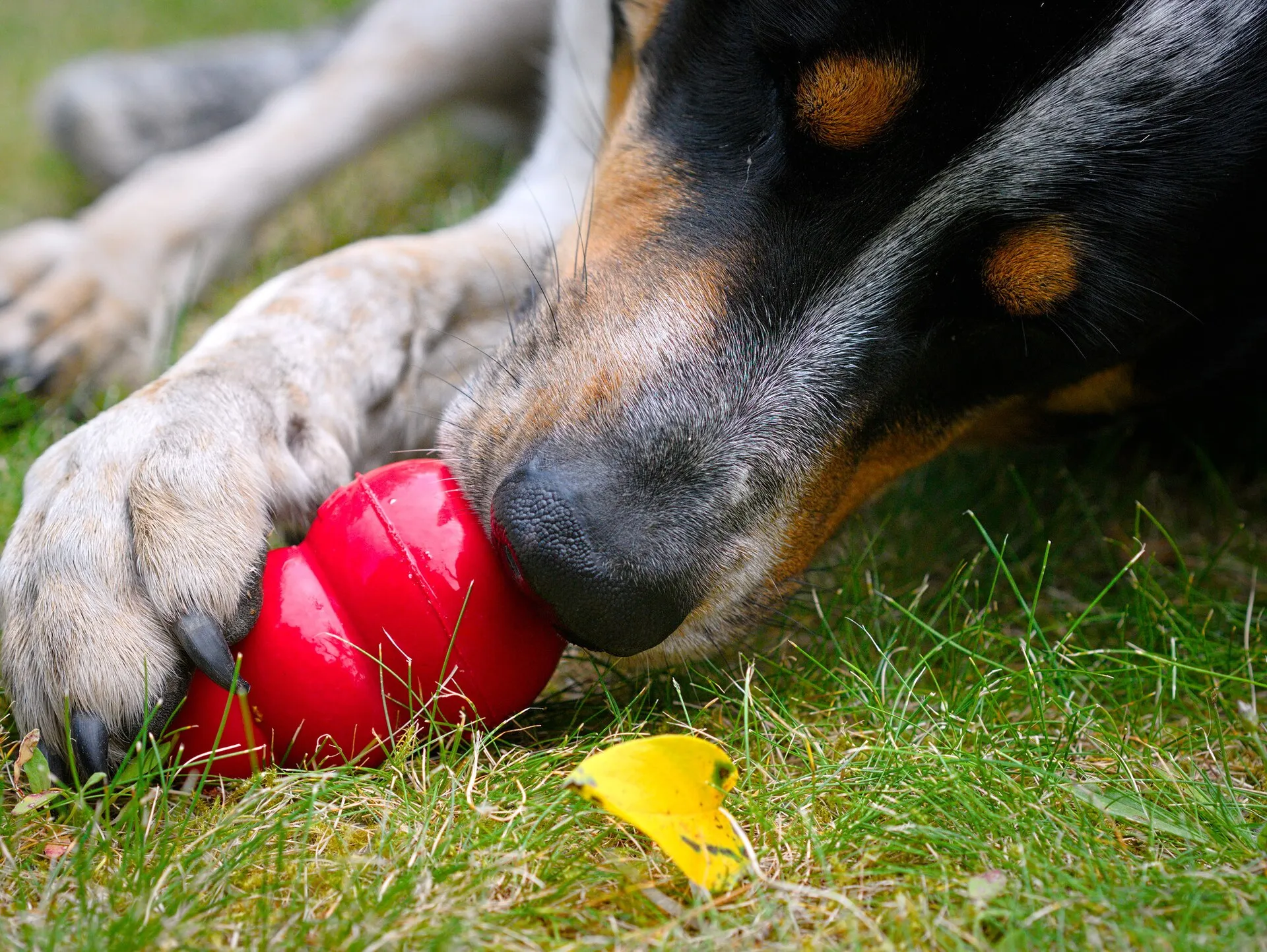
- Leave a long-lasting chew or food toy if your dog will eat it when alone. If they won’t, that’s a sign they’re worried.
- Close curtains or use a quieter room if outside noise sets them off. Some dogs settle better with a radio on.
What not to do
- Don’t punish. By the time you see the damage, your dog cannot link the telling-off to what happened, and it adds to their stress.
- Don’t let them “cry it out”. The RSPCA warns this teaches a dog that being alone is frightening and that calling for help doesn’t work.
- Don’t rely on a crate. It can make a panicking dog worse and lead to injury.
When medication is discussed
Medication is not a sign of failure. For dogs with moderate to severe distress, it can lower anxiety enough for training to work. Purdue University’s guidance notes it is typically considered when anxiety is severe, when there’s a risk of harm to the dog or others, or when behaviour modification alone is unlikely to be enough.
The Merck Veterinary Manual lists two drugs with US FDA approval for canine separation anxiety: clomipramine, a tricyclic antidepressant, and fluoxetine, an SSRI. Both are used alongside behaviour modification, not instead of it, and they take weeks to have their full effect. Your vet may also discuss short-acting medicines for specific situations. Licensing, brand names and availability vary by country, so what your vet can prescribe in the UK, Australia or India may differ from the US.
Only your vet can prescribe these drugs, and they should only be given under your vet’s direction. They may want blood tests first, and stopping some of them needs gradual tapering rather than an abrupt halt. Never give a dog human medication you have at home.
How to find qualified help in different countries
Anyone can call themselves a “dog behaviourist” in most countries, so check credentials. Start with your vet, who can rule out medical causes and refer you.
United States and Canada
- Board-certified veterinary behaviourists (DACVB): vets who completed a behaviour residency and exam with the American College of Veterinary Behaviorists. They can diagnose and prescribe. Search the ACVB directory at dacvb.org.
- Certified Applied Animal Behaviorists (CAAB): behaviour scientists with an advanced degree (often a PhD), certified by the Animal Behavior Society. They don’t prescribe but work alongside your vet. The ABS lists them in its CAAB directory.
- Certified behaviour consultants and trainers: for example the IAABC’s CDBC or CCPDT’s CBCC-KA. Purdue’s guidance notes that behaviour consultants are not regulated, so check what any credential required.
United Kingdom and Ireland
The Animal Behaviour and Training Council (ABTC) keeps a public register of assessed practitioners, including Clinical Animal Behaviourists (CAB) and Veterinary Behaviourists (VB). The Association of Pet Behaviour Counsellors (APBC) is one of the organisations that registers members on it. The RSPCA recommends using an ABTC-registered professional, usually on referral from your vet.
Australia and New Zealand
The ANZCVS Veterinary Behaviour Chapter publishes a list of behaviour vets, including registered veterinary behaviour specialists. Ask your vet for a referral, as many behaviour vets work on that basis.
Europe and elsewhere
In Europe, look for a vet recognised as a European Veterinary Specialist in Behavioural Medicine, awarded through the European College of Animal Welfare and Behavioural Medicine (ECAWBM). Elsewhere, ask your vet whether there’s a vet with postgraduate behaviour training nearby. Many specialists now offer remote consultations. Local law can matter too: in Sweden, for example, the national regulations require owners to accustom dogs gradually to being left alone.
The bottom line
Film your dog before you decide what’s going on, because boredom and distress can look alike from the wreckage. Get a vet check to rule out pain or illness, then train absences in steps small enough that your dog never panics, and arrange cover so they aren’t pushed past their limit in the meantime. For moderate or severe cases, a qualified behaviour professional and, where your vet thinks it’s right, medication can make the difference between slow progress and none.
Questions owners ask
Will getting a second dog cure separation anxiety?
Sometimes it helps a dog who mainly dislikes being without company, but many dogs with separation problems are attached to a particular person, and a second dog doesn't change that. You could end up with two dogs to manage. Get a proper assessment first.
Should I crate a dog with separation anxiety?
Usually not as a fix. Welfare charities warn that a panicking dog can injure themselves trying to escape a crate. Some dogs do feel safer in one, which is why filming your dog matters before deciding.
How long does separation anxiety training take?
Expect weeks to months rather than days. Progress is rarely smooth, and dogs often have setback days. The main thing is to avoid leaving your dog for longer than they can cope with while you train, which usually means arranging cover.
Is it my fault my dog has separation anxiety?
Usually not. Genetics, early experiences, health and life changes all play a part. Research does suggest some owner habits around departures and punishment can raise the risk in puppies, so calm, consistent handling is worth practising.
Sources
- RSPCA — Recognising separation-related behaviour and anxiety in dogs
- RSPCA — Training your dog to be left alone
- de Assis et al. (2020), Frontiers in Veterinary Science — Disambiguating Separation Related Problems in Dogs
- Royal Veterinary College — Risk factors for puppies developing separation-related behaviours
- Merck Veterinary Manual — Common drugs used to treat behavior problems in dogs
- Purdue University Center for Animal Welfare Science — How to find a behavior expert
- Animal Behaviour and Training Council — Practitioner organisations
- ANZCVS Veterinary Behaviour Chapter — Find a behavioural vet near you
This guide is general information, not a substitute for advice from a vet who has examined your dog. Every claim is checked against the sources above. How we research and fact-check. Spotted an error? Tell us.